Resistance remains the major limiting factor to curing cancer. SCO-101 is designed to dismantle the mechanisms tumours use to evade treatment.
Cancer drug resistance continues to be the major limiting factor to achieving cure for cancer patients. Our understanding of the underlying molecular and cellular mechanisms continues to develop with an ever-increasing number of new discoveries.
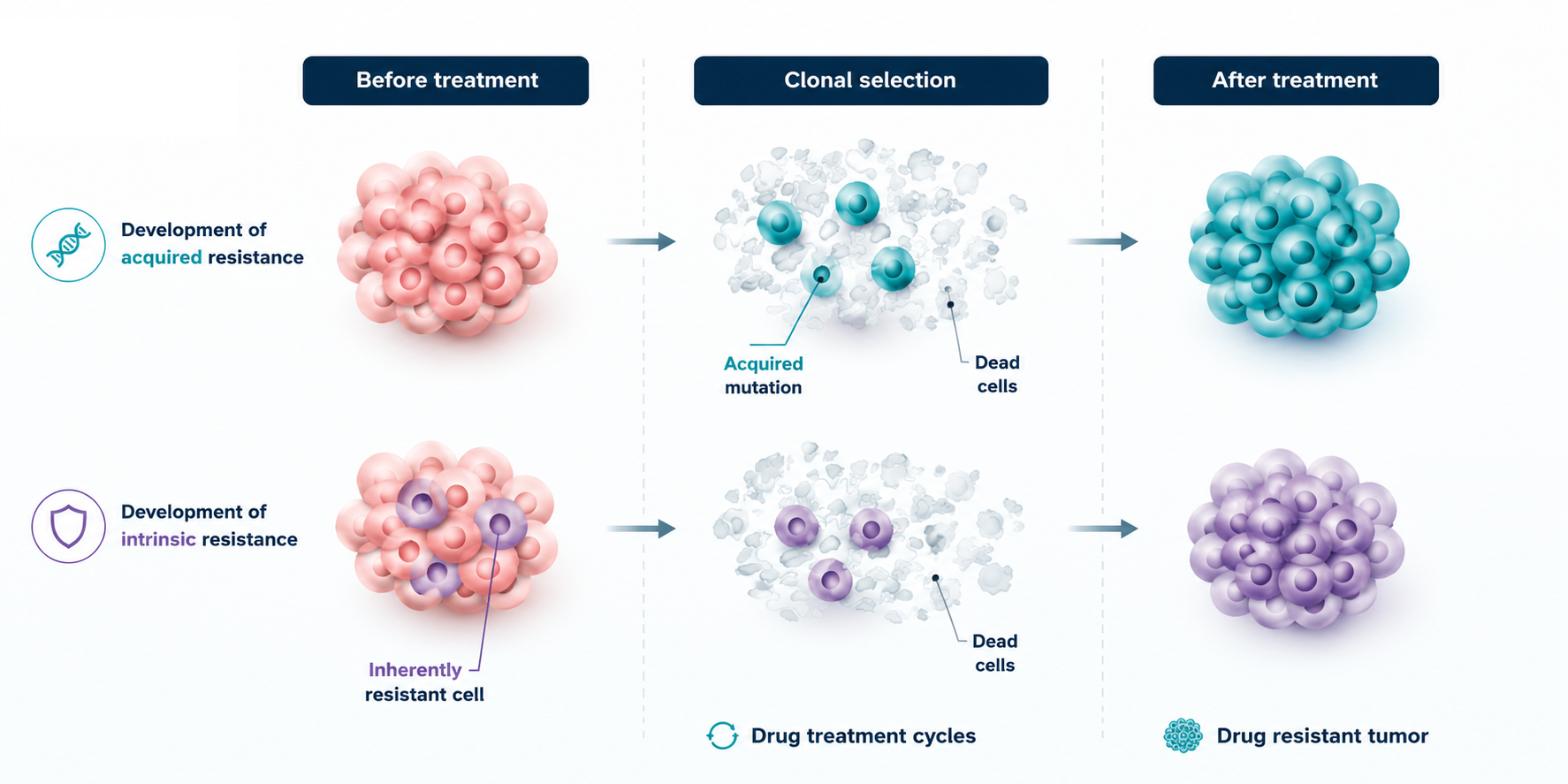
Resistance may be an intrinsic property of some cells or clones within a tumour. Over time, under treatment with a cancer drug, these cells become enriched — until the entire tumour becomes resistant.
Tumour cells can also progress through a series of genetic events. As defects and changes accumulate, the cells eventually become resistant. Under continued treatment, only resistant cells remain — and the tumour becomes resistant.
Scientific Publications describing SCO-101 / Endovion
Four phase 1 trials to evaluate the safety and pharmacokinetic profile of single and repeated dosing of SCO-101 in adult male and female volunteers.
Inhibition of ABCG2 by SCO-101 Enhances Chemotherapy Efficacy in Cancer.
PANTAX: a phase Ib clinical trial of the efflux pump inhibitor SCO-101 in combination with gemcitabine and nab-paclitaxel in non-resectable or metastatic pancreatic cancer.
Pharmacodynamic modelling reveals synergistic interaction between docetaxel and SCO-101 in a docetaxel-resistant triple negative breast cancer cell line.
CDK12-inactivation-induced MYC signaling causes dependency on the splicing kinase SRPK1.
Chloride channel blockers inhibit iNOS expression and NO production in IFNgamma-stimulated microglial BV2 cells.
H-ras transformation sensitizes volume-activated anion channels and increases migratory activity of NIH3T3 fibroblasts.
Cell cycle-dependent activity of the volume- and Ca2+-activated anion currents in Ehrlich lettre ascites cells.
Efflux Pharma's lead compound SCO-101 has a triple-acting mode of action and is used as a combination partner with anti-cancer drugs such as chemotherapy.
A potent inhibitor of the ABCG2 efflux pump and cancer stem-cell marker. Blocking it raises the intracellular concentration of cytotoxic chemotherapy — and cells with high ABCG2 are especially sensitive.
Independently of ABCG2, SCO-101 potently inhibits UGT1A1, which metabolises SN-38 — the active component of irinotecan — enhancing its plasma exposure and half-life in a modular fashion.
SCO-101 inhibits the kinase SRPK1, which is involved in endocrine-treatment resistance in cancer — addressing a third, distinct route of resistance.